| November 1: All Saints Day |
A NEW KIND OF SAINT
Investigating new doorways into Nature
| November 1: All Saints Day |
A NEW KIND OF SAINT
Interview - Physicist Nick Herbert on the latest Nobel Physics Prize on Bell's Theorem, Quantum Entanglement, and Non-local Reality
http://www.drfutureshow.com/?fbclid=IwAR14sVgx7HbfCseEzkKYkI1DXTPCS6XBZJg-7fhx-fsBZzUVXdWNjLMul3A&mibextid=34ey5e
Or
http://futurepeak.net/audio/DrF604_20221011_NickHerbert.mp3
Quantum physicist Nick Herbert is our special guest for the full two hours of today's show, speaking about the latest Nobel Physics Prize on Bell's Theorem, Quantum Entanglement, and Non-local Reality. He and John Clauser, one of this year's awardees of the prestigious prize, were colleagues together in the Fundamental Fysiks Group back in the 1970's, when this line of research was being explored.
Nick makes the point that Bell's Theorem was ignored back in 1964, when it was first espoused, not because it was bad science, but because it was looking at Reality, not theory, and physicists at the time considered Reality out-of-bounds for physics research.
So today we'll be taking a fresh look at John Bell's work, faster-than-light signaling, quantum encryption, quantum teleportation, making entangled photons, quantum computers, creating reality with our thoughts, and wondering whether consciousness is our reward for...'collapsing the wave function'?!! Enjoy!
![]() |
| Esalen Seminar on the Nature of Reality Poster |
In the late 1970s, Esalen Institute co-founder Michael Murphy decided to invite physicists down to Big Sur to see what might happen. One of Mike's speculations was that “Perhaps a new kind of inspired physicist, experienced in the yogic modes of perception, might emerge to comprehend the further reaches of matter, space and time.” So it happened that physicist Saul-Paul Sirag and myself found ourselves leading workshops on quantum mechanics for Esalen guests and holding yearly invitational conferences for selected scientists focused mainly on the theme of Irish physicist John Stewart Bell's non-locality theorem for quantum-entangled systems.
Quantum theory is one of our most successful mathematical tools for understanding the behavior of Nature at her most basic level. This theory has never made a wrong prediction and some of its results agree with experiment up to 13 decimal places. However its success is marred by what one might call The Reality Crisis. Though I have struggled with this theory for more than fifty years, I cannot tell my son Khola a simple story about how the world works on the quantum level. And neither can anyone else.
Quantum physicists represent the world in two ways depending on whether the world's being looked at or not. Waves of possibility when not looked at; And an actual particle when we look. Plus physicists don't really know what “looking” means — an embarrassing situation called “the measurement problem”. Wanna stump a physicist? Ask him (or her) what they think it takes to turn many shimmering quantum possibilities into one hard quantum fact.
Oddly enough, The Reality Crisis (physicist's inability to tell a good quantum story) does not hamper at all our ability to use this wonderful tool to make successful predictions. So, for the most part, practical physicists have consigned “thinking about reality” to the philosophers, to physicists who have already made their mark in the world and to amateurs (from the French word “to love”) who have no reputation to lose. “Do not keep saying to yourself if you can possibly avoid it,” warned physicist Richard Feynman, 'But how can it be like that?' because you will go 'down the drain' into a blind alley from which nobody has yet escaped. Nobody knows how it can be like that.”
To explain how one particle becomes actual is puzzling enough, but the stakes are raised once two particles are involved, especially if they happen to be created in a state of “quantum entanglement”. Then, when unlooked at at least, the two entities do not possess their own attributes. Only the union of the two is in a definite state of being, until a measurement is made. Erwin Schrōdinger was the first to point out the peculiar nature of entangled quantum systems and to comment that this strange mode of being was what most distinguished the quantum world from everyday stuff..
But in Schrōdinger's day, entangled quantum systems were hard to come by. So quantum entanglement, for the most part, remained a theoretical curiosity, if it was even mentioned at all.
That all changed in 1964, when a physicist named John Stewart Bell, whose hobby happened to be quantum reality, discovered, during a sabbatical leave from his day job at CERN accelerator, what is now know as “Bell's Theorem.”
![]() |
| The Bell Experiment |
Imagine a source S of polarization-entangled photon pairs A and B. Photon A is sent to Alice and photon B to Bob who each have a device that measures photon polarization. One of the important features of a quantum measurement is that Alice cannot just ask “what properties does her A photon actually possess?” but must make a choice of what attribute to ask about and which attributes to leave unknown.
Quantum attributes come in complementary pairs (and often triplets). If you ask about position, you forego finding out about momentum, a discovery attributed to Heisenberg, known as “the uncertainty principle”. Photon polarization happens to be one of those quantum attributes that is triplely uncertain, so when Alice chooses to measure one photon polarization plane, she necessarily forfeits all knowledge of the other two polarization planes.
At both Alice and Bob's stations, imagine a clock face that represents the direction that the two experimenters choose to interrogate their photon's unknown polarization. If Alice chooses to ask at 12 o'clock, a PLUS in her detector means that her A photon polarization is Vertical (V); a MINUS means that its polarization is Horizontal (H).
Two features of this system are typical of an entangled state:. 1. No matter what their clock settings, each observer always gets a random sequence of PLUSs and MINUSs; 2. Whenever Alice's setting is the same as Bob's, if Alice gets a PLUS, Bob will always get a MINUS and vice versa. Their results are said to be 1. Perfectly random and 2. Perfectly anti-correlated.
Since polarization-entangled states were almost non-existent in 1964, nobody really knew if this would actually happen to Alice and Bob, but a simple quantum calculation gives the result quoted above.
Physicists “represent” an unobserved quantum system by a mathematical entity called a wavefunction. I carefully use the word “represent” rather than “describe” because we don't really know what the real relationship is between the wavefunction and the actual world, another embarrassing situation called “the interpretation problem”. Physicists know how to use the wavefunction to correctly calculate (the probability of) all experimental results but they don't really know what the wavefunction means.
So what more does this magnificently useful but utterly mysterious wavefunction say about the Alice and Bob experiment?
First: Quantum theory says that whatever happens is entirely independent of the distance between Alice and Bob. If they are in the same room, as in most practical physics experiments, the results will be exactly the same as if they were ten thousand light years apart, separated by vast interstellar distances.
Second: While unobserved, the wavefunction does not assign any polarization attribute to either Alice's or Bob's photon, but when Alice measures her photon, using a clock direction of her choice, her photon instantly acquires a definite value, AND SO DOES BOB'S PHOTON even though Alice and Bob might be separated by galactic distance. This instantaneous connection, if it is real and not just confined to the theory, violates all the norms of modern physics.
Alice's apparently instant action on Bob's photon has gotta be faster than light (goodbye Einstein) but that's only part of the trouble. This interaction, unlike any we are familiar with in physics, is not diminished by distance. Furthermore, this Alice-Bob intimacy is not transmitted by any field we know of-- it just happens. Alice's action on Bob's photon is, in brief, unmitigated, unmediated and immediate.
Physicists label such alleged behavior, as “non-local”, a tame word that conceals their deep intellectual loathing for an unholy abomination, for a deeply unnatural act. In the world of physics, a “non-local interaction¨, if such a thing ever occured, would be a mortal sin against the Holy Ghost. Non-local interactions are, in physicist's minds, comparable to believing in voodoo, which, come to think of it, is alleged by its practitioners to behave somewhat “non-locally” too.
Third: But what about Einstein? If Alice has access to a non-local interaction, can she and Bob exchange signals faster than light using entangled photons? Since quantum theory describes all experiments perfectly, it can easily answer this question. And the answer is NO. No superluminal signaling is possible using entangled photons. What forbids this is the randomness of each individual event which exactly smothers any alleged non-local Alice-Bob connection.
So what did Bell do with this strange situation? He went against Feynman’s warning about trying to tell a story about what's really going on. Bell's Theorem is not about quantum THEORY, not about quantum EXPERIMENTS, but about quantum REALITY.
Bell tried to imagine the most general model of reality that he could think of, using the term “hidden variables” to make his guesses amenable to mathematical calculation. He imagined all the influences that might go into forming Bob's polarization measurement and left out just one: Alice's choice of what to measure. If Alice's choice is allowed to influence Bob's result, that would imply the existence of a real (we're talking about reality here) non-local interaction in Nature.
Using this one assumption, Bell calculated a set of inequalities that the EXPERIMENTAL RESULTS of any local model of reality must satisfy.
Guess what? The results predicted by quantum mechanics do not obey the Bell Inequalities. Therefore REALITY MUST BE NON-LOCAL. Bring out your crosses and holy waters, folks. The witch doctors is loose!
The reception of Bell's remarkable proof, which was published in 1964, in an obscure and rather short-lived journal, was a resounding silence. John Clauser, then a graduate student at Columbia, discovered Bell's Theorem in 1969 and wrote him about the possibility of doing an actual experiment to check whether the quantum predictions were correct. Bell reported that this was the first comment on his paper he had yet received—more than four years after its publication.
You often hear it said that when Albert Einstein published his Special Theory of Relativity, only six people understood it. In truth, there were probably lots more than six. But it is fair to say, that when John Bell published his now famous paper, ONLY SIX PEOPLE CARED. John Clauser was one of them.

For the next part of the story I quote David Kaiser's “How the Hippies Saved Physics” which discusses Clauser's accomplishments in great detail.
“Clauser, a budding experimentalist, realized that Bell's theorem could be amenable to real-world tests in a laboratory. Excited, he told his thesis advisor about his find, only to be rebuffed for wasting their time on such philosophical questions. Soon Clauser would be kicked out of some of the finest offices in physics, from Robert Serber's at Columbia to Richard Feynman's at Caltech. Bowing to these pressures, Clauser pursued a dissertation on a more acceptable topic—radio astronomy and astrophysics—but in the back of his mind he continued to puzzle through how Bell's inequality might be put to the test.”
| John Clauser lecturing at Esalen |
I first met John Clauser in his lab at Berkeley in the early 70s where he had cobbled together an ingenious device to test the Bell Inequalities using the few entangled photons that a mercury-vapor lamp produces. He hoped he would gain fame by showing that, for this particular system, quantum theory was wrong, and Reality was Local, as Einstein would have guessed. He succeeded however in finding that quantum theory was right, which means, according to Bell's Proof, that Reality must be non-local! This world, all that we can see around us, remains stubbornly local, but is undergirded, at least in the case of entangled photons, by a network of instant invisible voodoo-like connections.
I was introduced to Clauser as a member of Elizabeth Rauscher and George Weissman's Fundamental Fysiks Group and marveled at his Rube Goldberg setup for measuring polarized-photon coincidences. (He was using pile-of-plates polarizers, for Gods sake!) In addition to recruiting experimentalist John Clauser, FFG also attracted Henry Pierce Stapp, a Berkeley theorist interested in fundamental questions. All of our later ESNR meetings included Clauser and Stapp as core personnel.
Henry Stapp pushed us to closely examine every assumption that goes into Bell's proof, especially those that seem most self-evident, and Clauser kept us posted on other Bell Inequality tests besides his own that were being planned and carried out around the world.
The title of our Esalen Conference: Esalen Seminars on the Nature of Reality, was neither silly nor pretentious. We really were studying “reality” as physicists might view it, as an attempt to tell a story about what's actually going on behind the wavefunction mystery and the measurement mystery. For our ESNR motto we chose a quote from Goethe's Faust, who was also a passionate seeker of Reality. Attesting to the real strangeness of our quest, Clauser's colleague Abner Shimony dubbed these Bell tests "experimental metaphysics."
Our third Esalen meeting (ESNR #3) in 1982 featured a ceremony sponsored by Charles Brandon, one of the founders of Federal Express, to award both John Bell and John Clauser “The Reality Prize” of $3000 each for their firm establishment through theory and experiment of non-locality as a general feature of the world. Bell's Reality Prize was accepted by French physicist Bernard d'Espagnat since Bell could not be there in person. We assured the participants that this prize was merely the first of many that would be bestowed upon the two of them.
![]() |
| Reality Prize Announcement: Esalen Catalog |
In 2010, John Clauser, Alain Aspect and Anton Zeilinger were awarded the prestigious (Ricardo) Wolf Prize.
And just last week, the same three men were honored with the 2022 Nobel Prize in Physics.
Hearty congratulations to all three of you, O bold and noble champions of quantum reality!
![]() |
| Clauser, Zeilinger, Aspect: Physics Nobel Prize 2022: Quanta Magazine |
![]() |
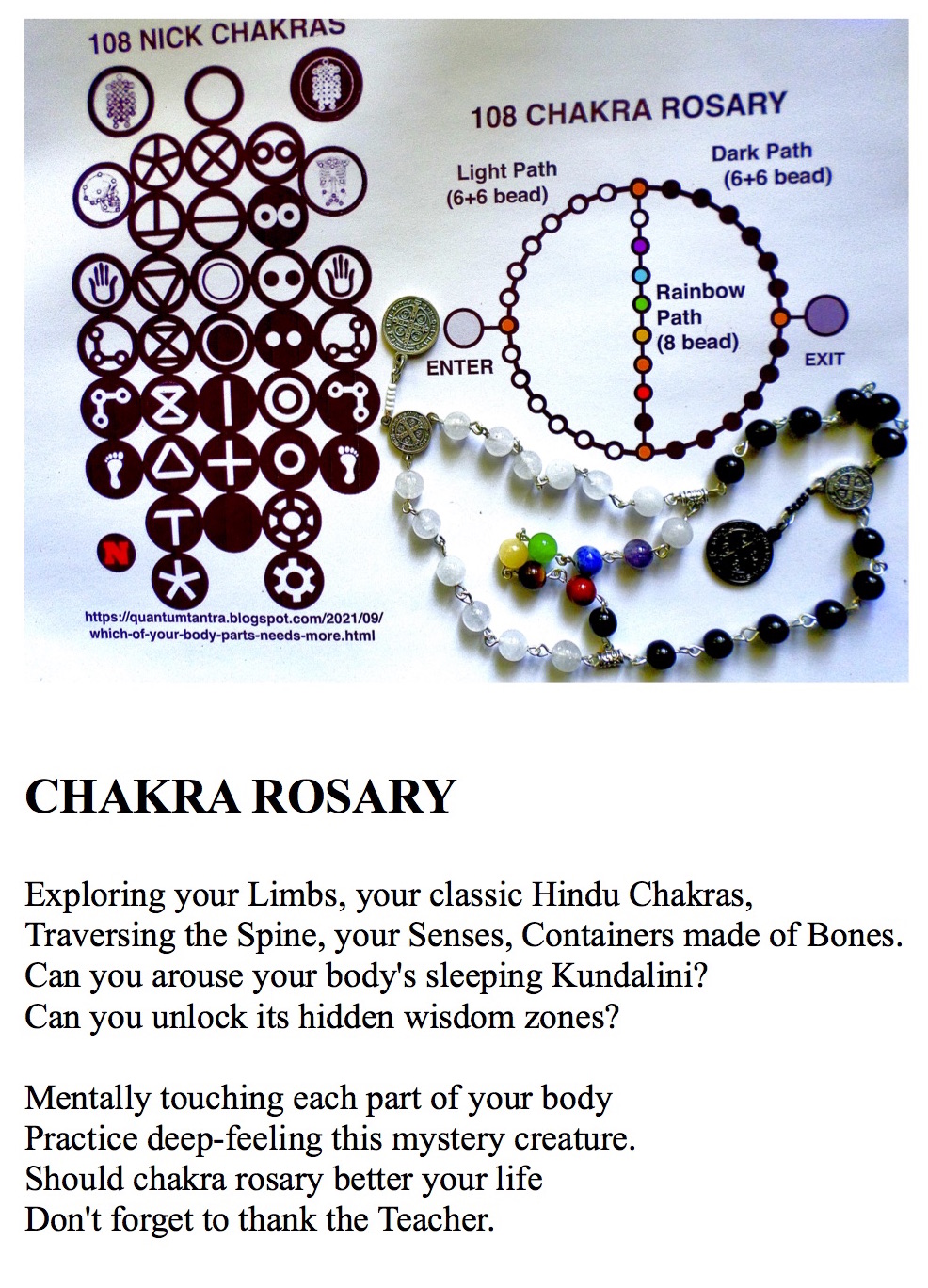
| 108 Chakra Rosary (Version Two) |
| Compact 108 Chakra Rosary |
This compact 108 chakra rosary consists of an outer loop of 24 beads, half of them dark and half lite corresponding to my division of chakras into dark and lite, the dark chakras located primarily in the lower parts of the body and the lite chakras situated on top. This outer loop is mostly used to count the 48 Limb Chakras--the 24 Right Limbs circling the loop in CW (Clockwise) direction and the 24 Left Limbs circling in CCW (CounterClockwise) direction. This outer loop is bisected by a string of 8 rainbow beads which are used to count the five 8-chakras sets: Spinal, Hindu, Sensual, Pelvic and Rib-Cage Chakras. The outer loop is also used to count the 18 Cranial Chakras.
In the center of the lite beads is a LITE link which attaches to a Lite Disk on which the rosary begins. In the center of the dark beads is a DARK link which attaches to a Dark Disk on which the rosary ends. Two other compact rosary landmarks are the TOP link and BTM link on which the 8-chakra sequences start and end.
| Intro or Antiphon Move |
Move #0: Starting at the Lite Disk, move onto the LITE link and follow the 6 lite beads to the TOP link. These six beads are merely an excuse to move to the TOP link where the rosary proper begins. Counting these first beads is the time to formulate why you are focusing your attention on your body's Somatic Stations, whether out of curiosity, exploration, gratitude, meditation or just to practice the moves. These six beads correspond roughly to the Antiphon beads of a Catholic rosary.
| Move #1: 24 Right Limb Chakras |
Move #1: 24 Right Limb Chakras. The chakra rosary proper starts at the TOP link and begins with the RIGHT FOOT chakra. Moving Clockwise (CW) around the outer beads, touching all 24 beads and returning to the TOP link. Each of the four chakra symbols: Right Foot, Right Leg, Right Arm and Right Hand represent six chakras. An example of dark/lite symmetry: the Right Hand Chakra is the lite partner to the dark Right Foot Chakra; The Right Arm Chakra is the lite partner to the dark Right Leg Chakra.
Beginning on the first six dark beads:
19. Five Finger, 20. Four Finger, 21. Three Finger.
The purpose of the chakra rosary is to focus your attention on otherwise neglected body parts. It is not a speed contest, although you may want to pay attention to some parts more than others. "Pay attention" -- an unusual phrase: the monetization of consciousness?
| Move #2: 8 Spinal Chakras |
Move #2: 8 Spinal Chakras. Beginning at the TOP link, move down the 8 rainbow beads, counting the chakras in Lite/Dark groups of two, each lite chakra paired with its dark partner.
25, Will, 26. Auto
27. Neck, 28. Tail
29. Thorax, 30. Pelvis.
31. Lumbar, 32. Perineum.
Where here Will stands for the voluntary nervous system, some of whose plexuses are located along the spine. And Auto represents the Involuntary nervous system to which strictly speaking you cannot really focus your attention. However on this Auto bead one can contemplate the importance of our unconscious bodily operations and give them some appreciation..
Although we humans do not possess tails, the Neck/Tail pairing associates the cervical vertebrae with the coccyx (or tailbone).
The Lumbar is paired with the Perineum because both are saddle-shaped.
| Move #3: 8 Hindu Chakras |
Move #3: 8 Hindu Chakras. These are my own variations on the seven classic Hindu chakras. The major changes are the addition of an eighth chakra (named Ground) so that the Dark/Lite pairing could be preserved. Also I invented simple traffic-sign-like symbols to replace the classic many-petaled lotus designs.
Starting at the BTM link and moving up the rainbow beads in Dark/Lite pairs we go:
33. Ground, 34. Crown
35. Root, 36. Brow
37. Sex, 38. Throat
39. Belly, 40. Heart.
I invented the new (dark) Ground Chakra as a partner to the classic (lite) Crown Chakra. The Ground Chakra represents our connection with the Earth and is located at the soles of the (bare) feet; the lite Crown Chakra represents our connection with Divinity and is situated at the top of the head. The dark circle symbolizing Ground could be the Moon or the Fertile Darkness; the lite circle symbolizing Crown could be the Sun or Cosmic Enlightenment.
The vertical stroke in the dark Sex Chakra could represent either lingam or yoni; the horizontal stroke in its corresponding lite Throat Chakra could stand for either the vocal chords or the lips through which the voice emerges.
The dark Belly Chakra represents the center of gravity, the hara of Japanese martial arts. the lite Heart Chakra represents the body's feeling center, the hara of your emotional body.
| Move #4: 8 Sensual Chakras |
Move #4: 8 Sensual Chakras. These are eight ways your body interacts with the outside world.
Starting at TOP link we count down the rainbow beads in Lite/Dark pairs.
41. Eyes, 42. Ears
43. Nose, 44. Skin
45. Mouth, 46. Tongue
47. Lungs, 48. Bowels.
Note that the symbols for the Lite/Dark Chakra pair Nose/Skin are both two dots. The two Nose dots represent the nostrils and the two Skin dots represent the armpits.
| Move #5: 24 Left Limb Chakras |
Move #5: 24 Left Limb Chakras. Like the Right Limb Chakras, the 24 Left Limb Chakras are counted on the 24 outer beads but this time, starting at BTM link, the beads are encircled in the opposite direction --CCW (CounterClockwise) starting with the LEFT FOOT CHAKRA and counting in threes.
49. Left Foot, 50. Big Toe, 51.Two Toe. 52. Three Toe, 53. Four Toe, 54. Five Toe
55. Ankle, 56. Calf, 57. Knee. 58. Thigh, 59. Hip Joint, 60. Left Leg.
61, Right Arm, 62. Right Shoulder Joint, 63. Upper Arm. 64. Elbow, 65. Forearm, 66. Wrist
67. Five Finger, 68. Four Finger, 69. Three Finger. 70, Two Finger, 71. Thumb, 72. Left Hand.
| Move #6: 8 Pelvic & 8 Rib-cage Chakras |
After visiting 72 chakras, we next enter the realm of the Three Bony Containers: 1. the Pelvic Basin, 2. the Rib Cage and 3. the Skull.
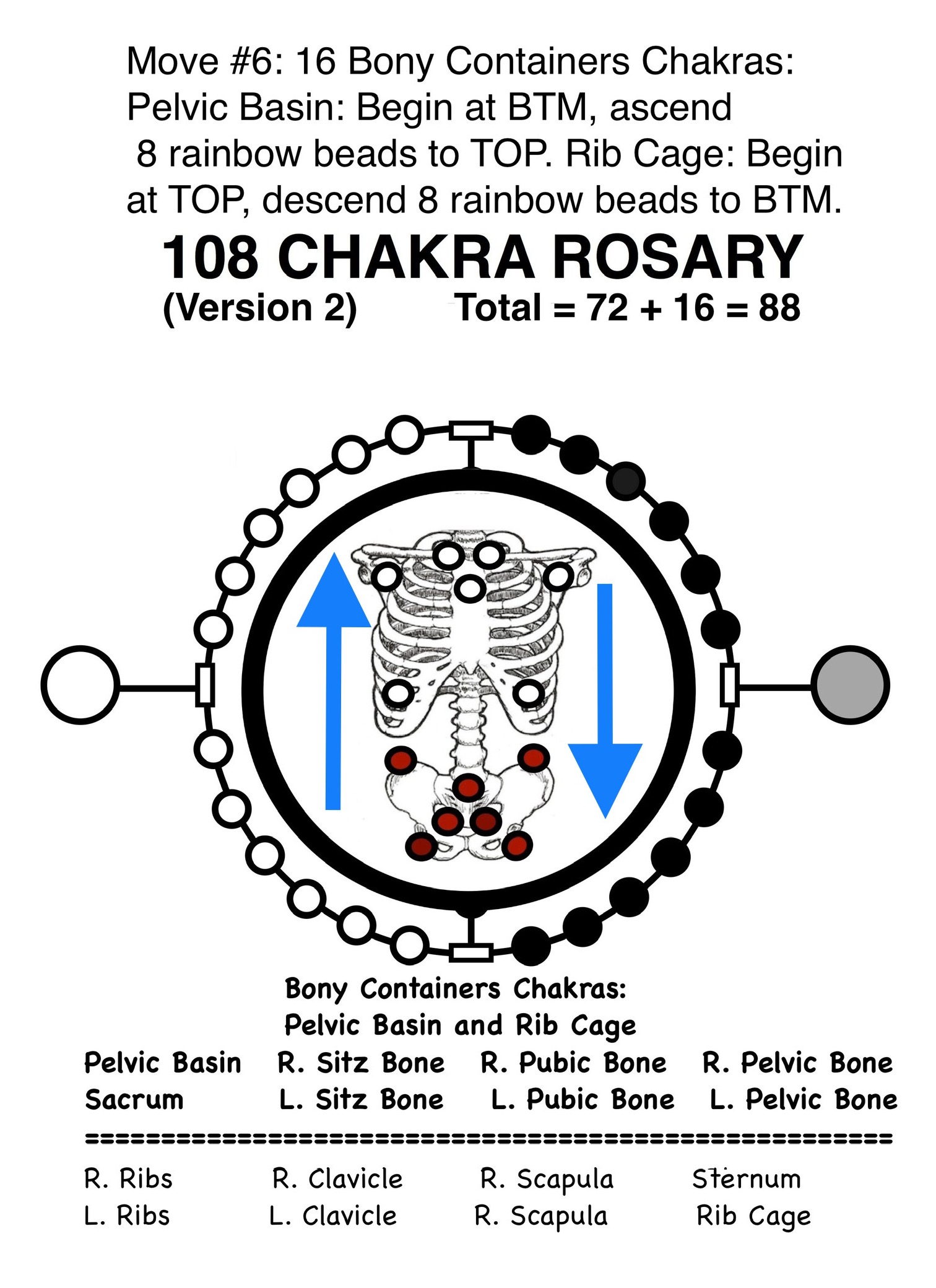
Move #6: 8 Pelvic & 8 Rib-cage Chakras. Starting at the BTM link we ascend the 8 rainbow beads in pairs. The Pelvic Chakras are all-Dark but we do not pair them here with their corresponding all-Lite Rib Cage Chakras.
73. Pelvic Basin, 74, Sacrum
75. Right Sitz Bone, 76. Left Sitz Bone
77. Right Pubic Bone, 78. Left Pubic Bone
79. Right Pelvic Bone, 80. Left Pelvic Bone.
Ending at the TOP link we now descend the 8 rainbow beads to BTM link
81. Right Rib Bones, 82. Left Rib Bones
83. Right Clavicle, 84. Left Clavicle
85. Right Scapula, 86, Left Scapula
87. Sternum, 88. Rib Cage.
Paying attention to only these 16 bones, you might notice that the Rib Cage resembles an upside-down Pelvic Basin.
| Move #7: 18 Skull Chakras |
Move #7: 18 Skull Chakras. Starting at BTM link, we ascend the outer lite beads in groups of three, two Right & Left paired lite Chakras plus a single dark Chakra:
89. Right Cheek Bone 90. Left Cheek Bone 91. Maxilla
A ROSARY FOR 108 CHAKRAS
One of the most important powers we possess is the ability to put our attention anywhere we please. In particular we can move our attention to any part of the body. A body part attended to is different from a body part ignored. A body part attended to "lights up" in a particular way.
To aid us in performing this mindful illumination of the body, I have been working for many years to increase the number of chakras (special body sites) from the classical seven Hindu chakras to a new and final total of one hundred and eight. Analogous to the particle/antiparticle symmetry of ordinary matter, I have applied a rough dark/light symmetry to my chakras. Each "light" chakra possesses a corresponding "dark" partner. In general (but not always) the dark chakra is located lower in the body than its homologous light partner. I have also tried to devise symbols "as simple as traffic signs" to represent both the classic chakras and my numerous additions.
Nick's new system consists of 108 locations in the body into which you can place your awareness and "see what happens". (Some of these places may already be clamoring for your attention by being painful.) See Which of Your Body Parts Needs More Amour for more details of this system.
Once having designated these bodily locations, I wanted to invent a systematic way of touring them. There are thousands of possible tours (actually 108! = 108 factorial which my computer informs me is a number with 175 digits.) So the particular body tour I have chosen is certainly not unique but for me it seems to possess a certain logic that makes it easy to remember.
Most of the chakras fit into one of three groups: Limb Chakras, Central Chakras and the Bony Containers
1. The 4 Limb Chakras:
Right Leg:Foot Chakras (12)
Right Arm:Hand Chakras (12)
Left Leg:Foot Chakras (12)
Left Arm:Hand Chakras (12)
For a total of 4 x 12 = 48 Limb chakras. (The underline indicates that all these chakras are "dark" Compare for instance, the "dark" Foot Chakras with the "light" Hand Chakras.)
2. The 3 Central Chakras:
Hindu Chakras (8)
Spinal Chakras (8)
Portal Chakras (8) (formerly called "Sensual Chakras")
For a total of 3 x 8 = 24 Central Chakras. Each dark Central chakra is paired with a light Central chakra. I am using the convention that upper-case "Chakra" refers to a group of body parts while lower-case "chakra" refers to one specific site. For example, the classic Hindu Chakras are eight in number, including the famous ("light") Heart chakra, whose "dark" partner is the Belly chakra.
3. The 3 Bony Containers
Pelvic Basin Chakras (8)
Rib Cage Chakras (8)
Skull Chakras (18)
For a total of 8 + 8 + 18 = 34 Bony Container Chakras.
To these 106 main chakras must be added a final two: the Whole Body chakra and the No Body chakra. The No Body chakra represents the entire Universe minus a tiny you-shaped piece. This final chakra stands for everything that is not your body, a distinction, which, as Alan Watts reminds us, may not be that easy to make: where exactly does your body end and the external Universe begin?
NICK'S BASIC 108 CHAKRA ROSARY
The simplest 108 chakra rosary would consist of 108 beads, each bead in the form of or depicting one of the chakra symbols shown above. Such a rosary would be large and difficult to produce. (Although the task might be made easier with the use of a 3D printer.) For my own purposes I have designed a smaller rosary consisting of only 32 beads. Nick's 32-bead rosary is more compact than the simplest rosary but explaining how to use it to visit all 108 chakras is more complicated.
Nick's Basic Chakra Rosary is made of 12 Light beads, 12 Dark beads and eight Rainbow beads plus a Light Disk and a Dark Disk which mark the beginning and end of "saying the Chakra Rosary". (In this photo, bad lighting unfortunately makes the Light Disk appear Dark and vice versa.)
As a rough guide to saying Nick's Chakra Rosary, the Light and Dark beads are used to "say" the Limb Chakras which come in groups of sixes, while the Rainbow beads are used to "say" the Central and Bony Container Chakras which come in groups of eight. (The eighteen Skull Chakras are the only exception to this rule.)
Another peculiarity of this system is that except for the Central Chakras, most of the saying of the beads follows an obvious anatomical sequence. In the case of the three Central Chakras, however, the saying of the beads alternates between a Dark chakra and a Light chakra following only a rough anatomical sequence.
THE SAYING OF THE BASIC CHAKRA ROSARY BEADS
We publish here the first account of the saying of the Basic Rosary beads. Holding the rosary as shown above, with the Light beads on the left and the Rainbow beads oriented with the single Light bead at the top, the sequence begins on the Light Disk. As your fingers move down the six white beads, this is the time to form your Intention for saying the Rosary, You might speak a six-syllable phrase:. "Now This is My Body." or "Touching Flesh With Spirit.", for example. Or anything else, as you say these first six beads, that takes you out of the ordinary world and into the particular exercise space of giving focused attention to your various body parts using a string of glass beads as a visual/tactile aid.
After the six-bead introduction, the Basic Rosary proper begins on the first lower Dark bead which represents the WHOLE RIGHT LEG. The sequence continues up the first six Dark beads to count the six Right Leg Chakras:
![]() |
| Peter Lamborn Wilson (1945-2022) |
Peter Lamborn Wilson is dead.
Peter Lamborn Wilson was a prolific, controversial writer and researcher into the lives and beliefs of mavericks, misfits, hobos, punks and heretics. He is best-known for his coinage of the term Temporary Autonomous Zone or TAZ which can be applied to any spontaneous association of free people from Burning Man to improv dancing, especially those gatherings which maximize what Wilson liked to call "ontological anarchy".
As an Ontological Anarchist, Peter necessarily acquired an unusual resume'. Educated at Columbia, Wilson left New York in 1968 for a spiritual "Journey to the East" across the Islamic world from Morocco to Katmandu, seeking wisdom and teachers in tea houses, palaces and opium dens and settling finally in Tehran, where his presence coincided with Empress Farah Pahlavi's desire to spread Iranian culture into the West. At the Iranian Academy of Philosophy, Wilson was put in charge of English publication where he was able to translate the works of famous Islamic philosophers and poets, for instance (my favorite) The Drunken Universe: An Anthology of Persian Sufi Poetry with Nasrollah Pourjavady.
Wilson's academic tenure in Tehran was cut short in 1979 by the Iranian Revolution in which the Shah and his wife were replaced by the Ayatollah Khomeini (a minor poet himself in the tradition of Khayyam and Hafiz).
Back in New York, Wilson aligned himself with various fringe organizations among which was the Moorish Orthodox Church of America which Wikipedia describes as "a syncretic, non-exclusive, and religious anarchist movement originally founded in New York City in 1965 and part of the burgeoning psychedelic church movement of the mid to late 1960’s in the United States." MOCA traces its lineage back to a black Chicago religious leader from the 1920's, Noble Drew Ali, whom the Black Muslims also claim as their founder. More detailed information concerning this "religious anarchist movement" can be found on the web at the Moorish Orthodox Information Kiosk or in Wilson's own Sacred Drift: Essays on the Margins of Islam published by City Lights in San Francisco.
Wilson obituaries have appeared in such wide-ranging venues as The Global Ganja Report and the New York Times (!) so I will not repeat here what others have written but instead publish a brief account of how this ontological anarchist affected my own life.
In the early 80's computers were just beginning to enter our lives. Instead the photocopier gave rise to a web-like phenomenon called "zines", short for "magazines" in which anyone with a few dollars for stamps and access to a Xerox machine could become their own publisher. The quality of zines ranged from semi-professional to unreadable but what they all had in common was quirky originality and instant access to off-beat topics. I cannot locate in my records the zine in which I first encountered the writings of Peter Lamborn Wilson but it might have been Popular Reality which one archivist described as "distinguishing itself as an open forum for the most unpopular of opinions."
Connecting via one of the zines of that era Peter and I began a letter exchange concerning the Moorish Orthodox Church and he invited me to come visit him in New York should opportunity arise. So in the spring of 1986 on some errand involving physics and publishing I met the man himself in his third floor apartment on West 107th St just a few blocks from the Nicholas Roerich Museum.
Wilson lived in a rat's warren of books, papers and unusual objects from his Islamic travels, the centerpiece of which was an old mechanical Remington typewriter on which he composed his voluminous works, He seemed to have a dislike for computers and never quite moved into the digital age. Over a few tokes of crumbly hashish he regaled me with tales from his travels and invited me to become a member of the Moorish Church. It is customary to take an Islamic name and I knew nothing of that faith. Wilson's own Moorish name was "Hakim Bey" and several of his books, articles and performances appear under that name. "Well, you could do worse, Nick, than "Jabir", the 9th Century Islamic alchemist."
So Jabir it was. To which I later added "'abd al-Khaliq", designating myself as servant of one of the 99 names of God. A few weeks later I received from Hakim Bey a photocopied diploma certifying my new rank as "Adept of the Seventh Heaven."
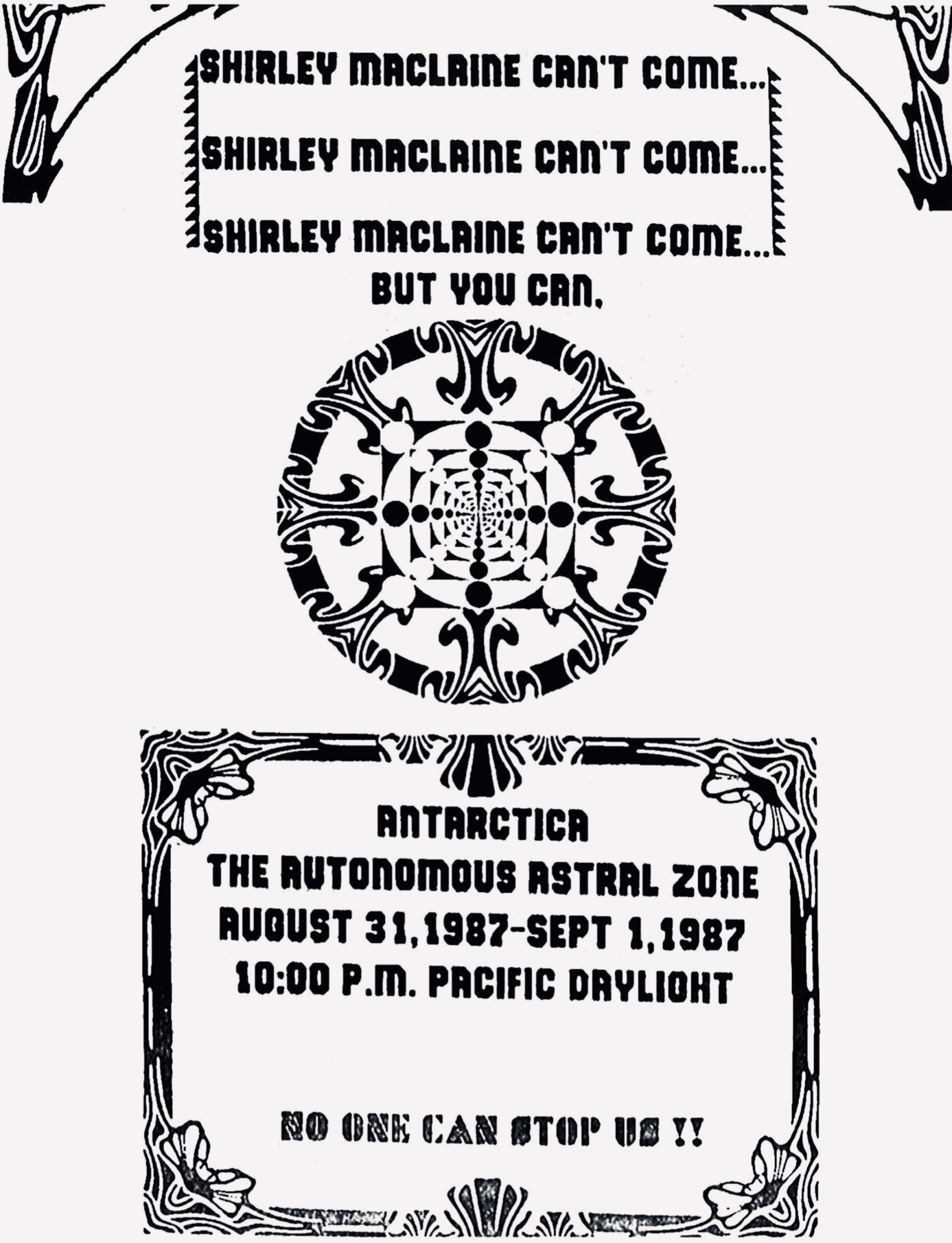
Another Moorish adventure as Doctor Jabir, this time in real space, was the Temporary Autonomous Zone San Francisco performance in 1993 organized and produced by the legendary Joseph Matheny. The site of TAZ SF was Komotion International, an art and performance space in San Francisco's Mission district. This event featured a dozen or so performers, both male and female, some of whom mingled with the audience. Hakim Bey himself was one of the stars and calmly lectured on some obscure feature of Ontological Anarchy. Most of us were attempting to be as outrageous as possible but Bey trumped us all by affecting an utterly conventional academic normality in an ocean of freaks. Jabir read some of his newest quantum tantric poetry, Robert Anton Wilson shared some of his latest provocative prose. Circus acts and dances followed and there was some sort of bondage scene going on that I had helped to prepare back stage.
MOCA produced at odd intervals the Moorish Science Monitor to which I sometimes contributed. And once I was a guest along with Robert Anton Wilson on the Moorish Orthodox Radio Crusade, an after midnight series hosted by Hakim Bey on New York's independent radio station WBAI.
Back in Boulder Creek I often enjoyed co-hosting our long running series of poetry readings with fellow Moor Omar abu Khan (aka Ed Cramer). But all in all, Doctor Jabir achieved the height of his Moorish identity in the call for Tantric Jihad which he has performed in venues as various as house warmings and Esalen Institute,
![]() |
| Jabir 'abd al-Khaliq declares Tantric Jihad |
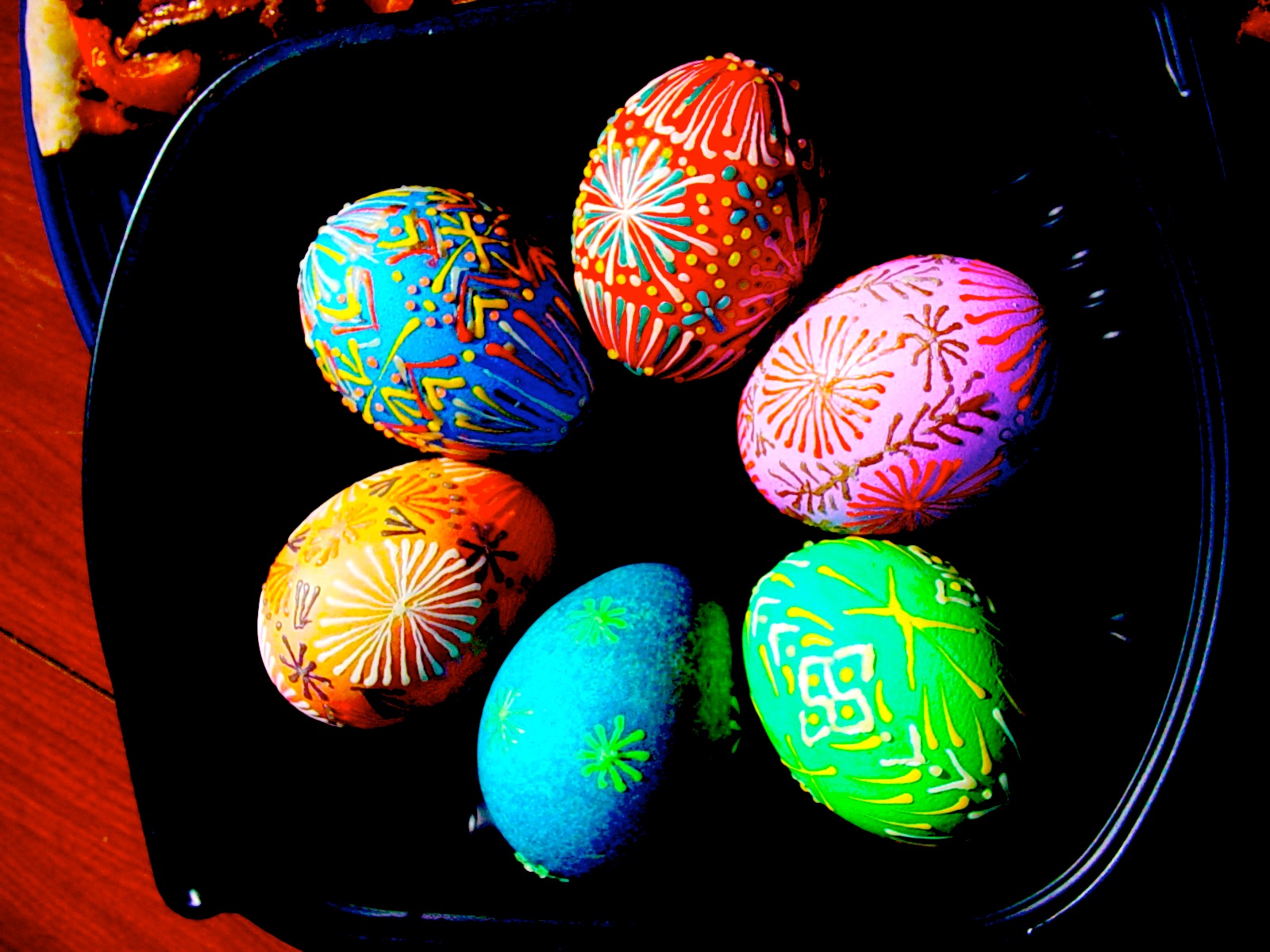
| August O'Connor decorating pysanky in Boulder Creek |
Easter begin as a pagan holiday celebrating the Anglo-Saxon goddess Oestara, Our Lady of the Dawn, of the Spring, of Fertility and of Regeneration. The feast of Oestara was transformed by Chrisians into the Feast of the Resurrection of Christ, the most joyous day in the liturgical calendar. What better symbol of fertility and new beginnings than the egg!
Ukrainian Easter eggs are called pysanky and (my father being Ukrainian-American} each year during Holy Week, our family would gather around the gas cooking stove in Columbus, Ohio and decorate hard-boiled eggs with pinheads dipped in molten wax heating on the stove. On Easter Sunday my family would attend solemn High Mass at St Augustine's Church across the street, then return home for a hearty dinner usually centering around baked ham and mashed potatoes. We ate the ugly pysanky and displayed our best eggs in baskets, on shelves and exchanged them with friends.
| Some pysanky from Nick and August |
In this year 2022 witnessing sad struggle between passionate kinsmen over the future of Ukrainia. Knowing that Russians and Ukrainians share a common Slavic soul, for we Slavs to harm or harass one another benefits only Satan. One can only hope this Easter that some unanticipated miracle will occur, a miracle as great as the one symbolized by these decorated eggs, a miracle no better expressed than by John Updike's powerful Oestarian lines:
SEVEN STANZAS AT EASTER
April Fool's Day, the coming of Spring, the beginning of Ramadan, a few weeks before Passover and Easter: a good time to repost this brief summary of one of the goals of quantum tantra: a brand new more intimate way of experiencing Nature that might someday replace science, religion, philosophy and common sense.
Ten Years Old Quantum Tantra Blog is now 10 years old. Happy Birthday, old friend! During its life QTB has published 495 posts which h...