Showing posts with label Lynden Stone. Show all posts

Saturday, October 18, 2014

Neville's Brain

Although Neville's brain was in a state of superposition, he was, when fully probed, a naive realist. Lynden Stone 2014
Lynden Elizabeth Stone is an Australian visual artist who explores the richness and ambiguity of existence using metaphors derived from quantum physics. I first met Lynden in the context of her Metaphase Typewriter Revival project where she reproduced with modern technology a nutty old experiment of mine put together at the dawn of the computer age that explored the conjecture that elemental quantum randomness might be used by spirits, both embodied and immaterial, to communicate in human language if a suitable computer interface were provided.

Lynden recently came to America as an artist in residence at Crane Galleries in Philadelphia where she exhibited the revived metaphase machine and other work concerning the ambiguity of existence. She just now completed her PhD at Griffith University in Queensland for a thesis entitled Doubting Conventional Reality: Visual Art and Quantum Mechanics in which she surveys contemporary visual artists who are using quantum-physics metaphors in the visual arts -- including her own work in this arena.

Part of Lynden's PhD thesis included a public exhibition of her work. She asked me to contribute some program notes for this show and promised me "an original art work" in exchange. A few days ago I received in the mail a pizza-box-sized package that contained Lynden's art work Neville's Brain.

In one simple image Lynden invokes several famous physicists beginning with the image of the Moon in the upper left corner. Lynden renders this moon in lenticular photography which was invented by British physicist David Brewster (who also invented the kaleidoscope). In the present context the moon image also suggests Einstein's famous quantum question to physicist Abraham Pais: "Do you really believe that the Moon does not exist when nobody looks?".

The black-and-white background of Lynden's piece consists of distorted Greek letters "psi" which is the symbol for the wavefunction in quantum theory. Neville's superposed brain is reminiscent of the "Wigner's Friend paradox" in quantum mechanics as well as John von Neumann's conjecture that when humans observe a superposed quantum system, their brain states should also turn into superpositions.

The fact that Neville is a naive realist despite his superposed brain summarizes the basic quantum conundrum of why the world always appears "classical" despite the fact that physicists can prove that the world is entirely "quantum". Today, the real mystery is not quantum mechanics; the real mystery is why the world appears to humans to be stubbornly classical.

JUJITSU UNIVERSE
We house-broke quantum reality
Taught Schrödinger's Cat to purr
Now daily life's as uncanny
As atoms ever were.

At the bottom right is the fuzzy sketch of an animal which might possible represent the famously ambiguous Schrödinger Cat. Except that Lynden's animal looks just like a dog.

Thank you, Lynden Stone, for this rich and original work. I will treasure it like a quantum Picasso.

Erwin's Puss by Lynden Stone, housed at Centre for Quantum Dynamics, Griffith University, Queensland, Australia


Friday, January 17, 2014

Doubting Conventional Reality

Erwin's puss by Lynden Stone: housed at Centre for Quantum Dynamics, Griffiths University

"Should there not be sufficient space for all sorts of curiosities which in the end the distinction between "physical" and "psychical" loses meaning?"

With this quote from physicist Wolfgang Pauli, Queensland College artist Lynden Stone begins her PhD dissertation Doubting Conventional Reality: Visual Art and Quantum Mechanics. Her
dissertation surveys other visual artists' quantum-inspired attempts to blur the distinction between objective and subjective reality as well as describing her own works on this topic which include paintings such as Erwin's puss, video installations such as Kevin wondered if the Moon existed when he didn't look, experiments with a phantom-limb simulator, the Metaphase Typewriter Revival Project, projects using the Psyleron Mind Lamp and many more. Lynden was recently honored as Artist-in Residence at Crane Gallery in Philadelphia where she participated in a joint exhibition with conceptual artist Jonathon Keats. Next month (February) Lynden exhibits a sampling of her work as one final step in the completion of her doctorate degree.

Here's Lynden's press release for her exhibit. Readers of this blog who live near Queensland, Australia, will have a rare opportunity to test their ability to "doubt conventional reality" in several imaginative quantum-physics-inspired contexts created and constructed by Lynden Stone.

Announcement for Lynden Stone's Thesis Exhibition

Two Mars Bars and the love note from Robert Smeets is the final exhibition by Lynden Stone for examination of her PhD in Fine Art at the Queensland College of Art. Based on the premise that quantum physics demands a re-evaluation of conventional reality, Stone sets out to challenge the viewers’ conventional understanding of reality that is objective, mind independent and knowable.  Viewers can test their ideas of reality by using, for example, the mechanical Mind Dispenser. This work provides random quantum events that, arguably according to quantum theory, allow a viewer to select, in a race of gobstoppers, the colored lolly of their choice by using only their consciousness. The Mind Dispenser is a collaborative piece created by Stone and final year Griffith University engineering student Anderson Tepas and Professor Steven O’Keefe.

The title piece in the exhibition, In another universe, my mother gave me the two Mars bars and the love note from Robert Smeets, 1993--2013, is a work concerning the quantum theory of parallel universes. This theory states that at every moment of choice, all possibilities manifest into multiple, branching universes. Stone presents alternate scenarios behind two doors of a kitchen cupboard. Behind one door is a representation of her parallel life where, rather than hiding the Mars bars and the love note in the kitchen cupboard, her mother did give her these things. In that life, Stone has lived as the wife of Robert Smeets in London Ontario, winning some minor painting prize for an underwhelming pastel still-life at the local show. Behind the other door is a representation of the life she has lead in this time-line.

Two Mars bars and the love note from Robert Smeets is on show in the Webb Gallery, Level 1, Webb Centre, Queensland College of Art, 226 Grey Street, South Brisbane, Queensland from 5--15 February, 2014. Gallery opening hours are Tuesday -- Saturday, 11am--4pm. The opening night event is Friday 7 February, 6--9pm.
Lynden's daughter Madeline interacts with the Psyleron Mind Lamp

Friday, May 11, 2012

Greatest Pleasure

Baruch Spinoza (1632-1677)
 GREATEST PLEASURE

The ancient Greeks saw Nature sexualized
saw naked nereids in the streams
saw goat-foot satyr in the laurel grove
saw sexy dryads hiding in the trees.

Spinoza says our greatest pleasure's

the union of the mind with nature.
Can quantum theory cease to bore us—
bring back the Greeks' enchanted forest?

Can we concoct new physics lures
to call out spirits from the trees?
Can we seductively exploit
our Heisenberg uncertainties?


If we dressed up in Nature-wooing wet suits
weaved of coherent quantum oscillators
could we dally with dryads, flirt with nymphs 

and quantum-copulate with satyrs?

When will physicists expand their craft
by daring to suppose a
more creative kind of measurement—
the "greatest pleasure" of Spinoza?

A couple mind-linking in Philadelphia with Lynden Stone's Metaphase Typewriter

Thursday, May 10, 2012

Encounters With Quantum

Poster for Crane Arts Exhibit: May 10, 2012
I used to joke with my buddies in the Stanford physics department about the dangers of researching quantum reality. Look what a mess E = mc2 unleashed (atomic weapons, dangerous nuclear reactors, growing stores of radioactive waste) and that equation is essentially still classical and superficial--it doesn't really penetrate into deep reality. There are deeper mysteries than E = mc2--for instance, the quantum transition from possibility into actuality (P-to-A), which underlies everyday existence and which no physicist really understands. Messing with this process--the P-to-A transition--could lead to a "reality bomb" in which things that have already happened are simply erased as if they had never happened. Responsible governments have passed laws to keep Uranium, Plutonium (and marijuana) out of the hands of ordinary people because of the obvious dangers to civilization if these substances became widely available, but devices in which the quantum P-to-A transition is accessible are still not outlawed. At present anyone is free to mess with the fundamental process that brings this world into existence.

The Metaphase Typewriter is such a device. MT takes a fundamental P-to-A transition (radioactive decay) and turns the patterns of these decays into text and speech. MT explores the dangerous assumption that consciousness enters the phenomenal world by controlling P-to-A transitions. According to some thinkers, your brain may be such a P-to-A transition machine thru which "You" perceive and control (a part of) the world via this fundamental reality-creating process.

The Metaphase Typewriter is a P-to-A device which at present lacks a "soul" to animate it.

The Metaphase Typewriter is an open invitation for rogue consciousnesses, discarnate human spirits, alien minds billions of years superior to us in evolutionary fitness to insert themselves into our immature, childlike culture. Or human unimaginable forms of intelligence that will change our fragile culture in humanly unimaginable ways.

Construing MT as an "art project", Australian artist Lynden Stone has built and installed a Metaphase Typewriter at Crane Galleries in Philadelphia. She turned it on today. At the reception, crowds of sophisticated Americans will be sipping wine and socializing while the fundamental process that creates reality itself will be opening itself to occupation by any raw consciousness that decides to seize the day.

Congratulations, dear Lynden Stone, for accomplishing this feat before it becomes illegal.

Tuesday, April 3, 2012

Queensland Quest

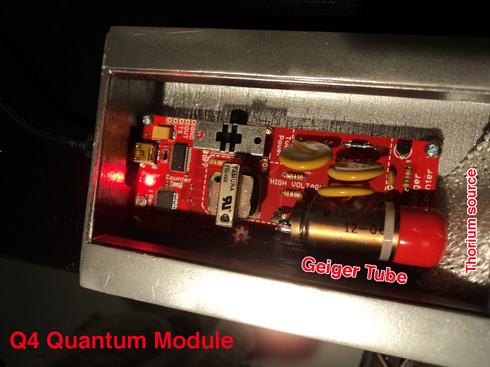
Lynden Stone's Quantum Module

Exactly 40 years ago I built a machine for creating consciousness.

It didn't work.

This machine (which I called the Metaphase Typewriter) was based on the assumption that consciousness is a wholly quantum effect. More precisely I assumed that the quantum randomness that seems to underlie the behavior of all matter is the universe's default setting. Events in a mindless universe would be truly random--a condition I called "the orthophase". Mind enters the world and changes its behavior by causing otherwise random events to conform to Will. Whatever parts of the world are entangled with Mind, I call "the metaphase".

The Metaphase Typewriter is a machine that generates pseudo-English text that originates from a quantum-random source (Geiger counter + Thallium 204 radioisotope). You can read about the MT here, here and in my book Elemental Mind.

Recently Lynden Stone, a conceptual artist at Queensland College in South Brisbane, Australia, has decided to build a new version of the Metaphase Typewriter using modern components instead of the Wright Brothers-class electronics available in the seventies. Lynden calls this machine the Metaphase Typewriter Revival Project (MTRP). I call it the Queensland Quantum Qonsciousness Quest or "Q4" for short.

Q4's logical structure is Quantum Module ---> Statistical Filter ---> Metaphase Text ---> Quantum Metaphone. In Lynden's realization the Quantum Module is a USB-powered SparkFun Geiger counter driven by radioactive Thorium 232; the statistical filter (devised by programmer Mervyn Ullrich Shrooms) uses the "random" pulses of the Geiger tube to select English words according to their relative probability plus applying a "grammar filter" that recognizes properly ordered parts of speech. A text-to-speech program called "Alex" produces audible output from the quantum-driven machine.

Lynden's MTRP is currently located at Queensland College of Art and is running on the web for two weeks at MTRP Site where you can access the output and try to influence it with your mind. (Note: words separated by commas represent attempts at sentences. When a complete sentence emerges, the commas are removed and a full stop added at the end.) The project will run online between April 2 and April 14, 2012; afterwards MTRP will be taken on tour including a week-long installation at Crane Arts in Philadelphia: May 7 to May 13, 2012.

O spirits of the metaphase
creatures of pure consciousness
voices from the other side
please use this small machine
to tell us
if you're so inclined:
what one thing can we humans do
to make this Queensland channel
more accessible
to disembodied minds?