Showing posts with label august o'connor. Show all posts

Wednesday, October 30, 2024

The Stag at Samhain

The Celtic Stag

THE STAG AT SAMHAIN

For several years Kim Fulton-Bennett and the late August O'Connor performed Irish music as a duo called "Dobhran" (Gaelic for "Otter") which later doubled in size to form "Blarney". Most of their tunes are traditional but a few are original compositions including one by August that she called "Samhain Damh" (Gaelic for ""The Stag at Samhain"). She intended this tune to evoke the mood of the Celtic season of Samhain (pronounced "sow-win") which we in America celebrate as Hallowe'en.

August and Kim performing as "Dobhran"

On Samhain the veils between worlds are supposed to become thinner and the Samhain Stag can be seen as either a guide or a ride between these world. When she was young, August imaged a stag with golden antlers and silver hooves that would appear at her bedroom window some nights and carry her wherever she wished to go.

The "worlds" this Samhain stag might take you to include not only the world of departed saints and sinners but also perhaps the mythical Celtic Otherworld called "Annwyn", a kind of Earthly paradise mentioned in the Welsh Mabinogion and in the Arthurian legends.

In these legends, the stag is often seen as leading brave men and women on quests of great importance, so if you are looking for adventure, this Samhain season might be a good time to request that Quest you've always wanted to be called upon to carry out.

This recording of "Samhain Damh" is taken from Dobhran's CD "Otter's Holt" and features August O'Connor on guitar and Kim Fulton-Bennett on Irish wooden flute and penny whistle.

Friday, March 29, 2024

Two Moods: Eclipse and Emergence

Heart eclipse projected onto a frame drum.

ECLIPSE
 
One of the ways
August expressed her sorrow
after her marriage
fell apart.
 
Eclipse of the Heart
San Francisco 1983 

ECLIPSE OF THE HEART 1983

EMERGENCE

On the other hand
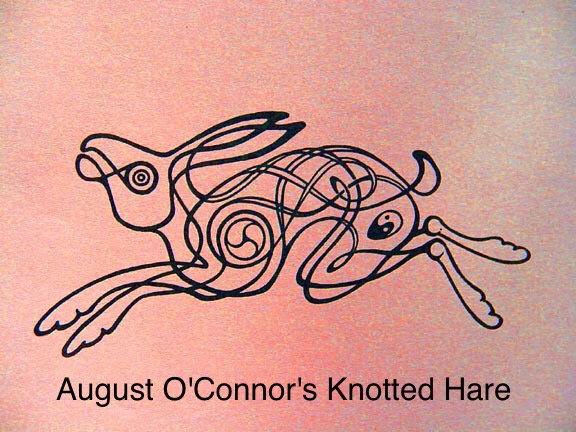
August's Knotted Hare 
Capitola 2002
expresses her fondness for every kind of animal,
Spring flowering,
one more joyous Easter:
our good Lord emerging from the tomb.
 

Monday, October 16, 2023

it's time to face this sex thing

August O'Connor

 it's time to face
this sex thing
 
It makes us men.
It makes us women.
It makes a joke
to please us
to see us smile.
It makes Beauty
to open our hearts.
It makes Love. 
 
            August O'Connor 
 

Thursday, July 6, 2023

August O'Connor (1951 - 2023)

August O'Connor in meadow with big bodhran.


 AUGUST O'CONNOR (1951--2023)

Born in Southern California in 1951, the middle girl between two brothers, Raleigh and Greg, August O'Connor early experienced a love of animals, drama and mystery. She raised pet rats and played with snakes. And face-painted, dressed in leotard, rabbit skins, leather aviator helmet and shaking a coyote-skull rattle, she entertained her high school classmates as "Animal Woman: Protector of all speechless creatures." She starred in student plays, performed in an all-girl band and, starting as a freshman, she edited her high school's literary magazine.
 
After graduation, while living in Claremont, she met and married Bill O'Connor. Shortly afterwards they moved to Capitola where they attended St. John's Episcopal Church before moving to San Francisco to work at Grace Cathedral.

For eight years at the Cathedral, August O'Connor served as assistant verger, supporting Bishop Swing in ceremony, designing vestments and providing counseling, For six years she worked as chaplain at San Francisco General Hospital during the rise of the AIDS epidemic.

In recorded conversation with San Francisco social historian Lynne Gerber about her AIDS and other work, August recalled: "Lots of different lives but there is a chaplaincy thread running though it. The thread is love, I'd say, the thread is willingness to love. And to be loved, you know, because when you open your heart to someone, you might not be loved, you know." August's motto, painted on her gate post, is: "Every blessing on all beings."
 
August has worked in every aspect of the visual arts from large oil paintings to cartoons. In the 70s she was Art Director of Good Times, Santa Cruz's largest weekly newspaper. She designed logos for several businesses including Zoccoli's Deli and Pink Godzilla; producing signs, murals and window displays for numerous local shops. She also fashioned necklaces, earrings, bracelets, Celtic knot tattoo designs and unusual hand-hammered copper sculptures based on double spirals which she called "Buddha-mind roller coasters."
 
After leaving Grace Cathedral, August and her friend Nick Gardner began attending Native American sweat lodge ceremonies in Marin and Shasta counties under the direction of Karuk medicine man, Charlie "Red Hawk" Thom. When she moved back to Capitola, August mentored under medicine man Indio, eventually running her own sweat lodge events when Indio became ill. August's sweat ceremonies, carried out with Nick Gardner on the beach a few miles south of Pigeon Point lighthouse, drew a wide variety of attendees primarily from the nearby University in Santa Cruz. Also with Nick Gardner, she enjoyed many trips into the wilderness which she loved. 
 
In her home in Capitola, on one city lot, August put together a voluptuous Mediterranean garden crowned by an orchard of olive, apple, plum, lemon, loquat and persimmon trees. In addition to wild profusions of flowers, the garden produced food – lettuce, tomatoes, beans and potatoes as well as fruit from its trees. August's garden was a haven for bees, butterflies, bats and small mammals and had been officially certified as Wildlife Habitat #29951 by the National Wildlife Foundation.
 
August was a splendid chef, could create a tasty meal out of most anything. At San Francisco gatherings, she garnered admiration for her party specialty: chocolate truffles. Her turmeric toast made an unusual breakfast treat and August's mushroom omelettes were arguably the best in the known universe.
 
August sang and played guitar and bodhran (Irish frame drum). With flute-and-whistle player Kim Fulton-Bennett, they formed the Celtic duo Dobhran (Gaelic for "otter") which played at weddings, wineries, coffee shops and private parties and they also recorded a few instrumental CDs. Dobhran has performed at numerous Scottish and Irish festivals in Santa Cruz and Ben Lomond. A familiar presence at local Irish music sessions, August recently started a new group called Blarney with Kim, Nick Herbert and Matt Johnson, which has performed on stage, at private parties and most recently at an Irish wake in Boulder Creek.
 
Friends have described August's character variously as "playful dignity", as "innocent sophistication", as "kaleidoscopic life force",  as "remarkable, unique, eccentric",  and as "a tempestuous whirlwind." She herself explained "My life/is one kiss/with life."
 
She was hospitalized recently in Santa Cruz for a serious infection. And, on March 24, a week after St. Patrick's Day, early in the morning at age 72, this former chaplain, artist, musician, sweat lodge leader, gardener, beautiful and loving woman, August (Augie) O'Connor, passed away peacefully in her sleep.

Says Nick Herbert: "August came from a larger place and shared some of that with the rest of us."

Said one good friend: "August filled pages; she was a tome."

Added another: "August was an Irish rose."


I LIKE MY HANDS
https://quantumtantra.blogspot.com/2023/07/i-like-my-hands.html


Sunday, June 4, 2023

Deep in my Head

August O'Connor

DEEP IN MY HEAD 
by August O'Connor
 
I was deep in my head
Deep in my head
Deep in my head
When you startled me.

I was deep deep
Deep in my head
When I saw you
And you startled me.

When I saw you
And you startled me
I saw you
And you startled me.

I would like to be
Startlingly beautiful
Deep in my head
When you startled me.

I would like to be
Startlingly beautiful
I would like to be
Startlingly fair, fair, fair.

Fairer than a rose
Fairer than a perfect rose
Fairer than a dawn
Fairer than a perfect dawn.

Fair as the light
Shining from my lover's
Bright eyes

Fair as the words
Spoken from my lover's
Sweet lips

Fair as the love
Deep at the heart of everything
I would like to be
Startlingly beautiful.

I was deep, deep
Deep in my head
When I saw you
And you startled me.


Tuesday, May 16, 2023

Kauffman Flypes Rolfson into O'Connor knot

August O'Connor, Celtic knot maker

KAUFFMAN FLYPES ROLFSEN INTO O'CONNOR KNOT

My friend and musical partner, August O'Connor, designed me a personal Celtic knot which became part of my business card plus a rubber stamp, and which she also painted on my back, my bald head and on a hat box containing my black derby hat.

O'Connor knot painted on a hat box

I recently discovered that knot theorists have classified knots according to the minimum number of their crossings and that the O'Connor knot is an example of a seven-crossing knot. According to the official knot table constructed by Dale Rolfsen there are only seven seven-crossing knots. So I naturally wondered which one of the seven Rolfsen knots corresponded to the O'Connor knot. After a simple but long and tedious calculation (presented in my previous post) I proved that the correct Rolfsen knot was 7--6.

In other words I had proved that it must be possible just by twisting and turning Rolfsen 7--6

The Rolfsen 7--6 knot

to transform it into the O'Connor seven knot. 


The O'Connor seven knot

By tying a big rope in the shape of the Rolfsen knot and trying over and over again to turn it into an O'Connor knot (which I had proved must be possible) I ended up with nothing but featureless tangles and usually was unable to even return to the original Rolfsen. Then I had to untie the rope and try again.

In short, Nick could prove it but not do it.

For reasons unknown to me, Nick's dilemma attracted the attention of prominent knot theorist Louis Kauffman who demonstrated a simple set of three moves that easily turn Rolfsen into O'Connor.

Knot theorist Louis Kauffman

 Kauffman summarized his three moves on a single sheet of paper which I reproduce here. He also hinted that he might assign this exercise to his students as a homework problem.

Kauffman's first move
 

The O'Connor knot might be visualized as two outspread wings positioned over a "tail". Kauffman noticed that the O'Connor "tail" already occurs in the Rolfsen knot at 2 o'clock on the standard diagram, So Kauffman's first move is to rotate the Rolfsen till the "tail" is now at the bottom at 6 o'clock.

Kauffman's second move


 For the second move we notice that the O'Connor knot's two "wings" are symmetric around the vertical axis but the Rolfsen knot is not. The Rolfsen knot has two crossings on the left-hand side (A) and zero crossings on the right (B), in the rotated sketch drawn by Kauffman.

For his second move, Kauffman then applies a twist that equalizes the number of crossings on the left and right hand sides. This twist (illustrated in the upper right corner of Kauffman's sketch) subtracts a crossing from one loop and adds it to the other. After this twist, technically called a "flype", both loops now contain the same number of crossings, and with a little bit of rearrangement, can be seen to resemble the "wings" of the O'Connor knot: Kauffman's third move.

Kauffman's third move

Kauffman's first and third move are nothing but simple reaarrangements that can be accomplished without lifting the knotted rope from the table. The real trick resides in Kauffman's second move in which he applies a simple twist (called a flype) at precisely the right position. The word "flype" is derived from a Scottish word meaning to skin or fold as in turning over the edge of a sock.

Now I know how to turn a Rolfsen into an O'Connor knot. And so do you.

With grateful appreciation for Louis Kauffman's timely aid, I offer for your enjoyment the seemingly effortless liveliness of August O'Connor's "Knotted Hare"

August O'Connor's "Knotted Hare"


Friday, April 15, 2022

Easter 2022

August O'Connor decorating pysanky in Boulder Creek

 EASTER 2022

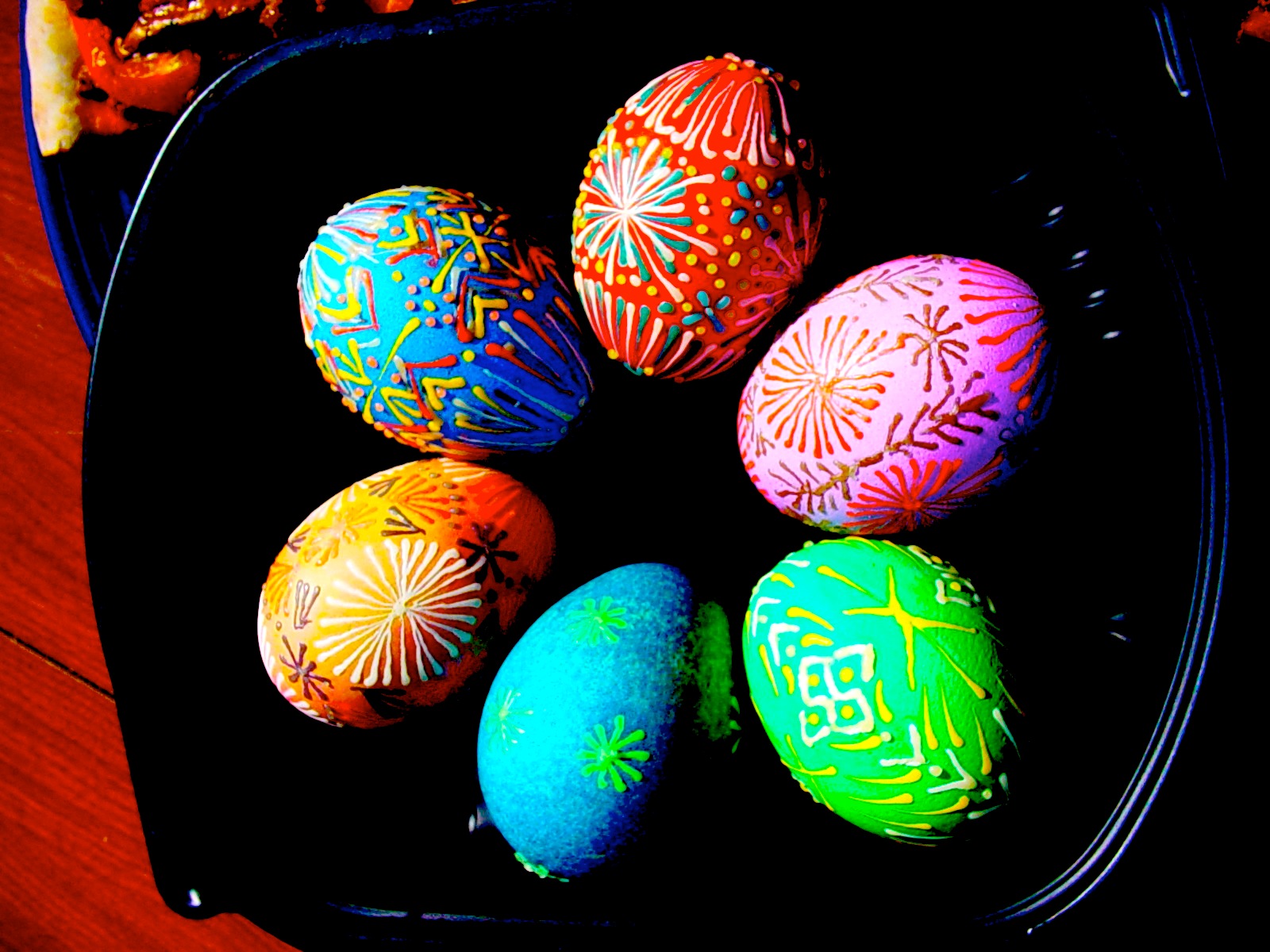
Easter begin as a pagan holiday celebrating the Anglo-Saxon goddess Oestara, Our Lady of the Dawn, of the Spring, of Fertility and of Regeneration. The feast of Oestara was transformed by Chrisians into the Feast of the Resurrection of Christ, the most joyous day in the liturgical calendar. What better symbol of fertility and new beginnings than the egg!

Ukrainian Easter eggs are called pysanky and (my father being Ukrainian-American} each year during Holy Week, our family would gather around the gas cooking stove in Columbus, Ohio and decorate hard-boiled eggs with pinheads dipped in molten wax heating on the stove. On Easter Sunday my family would attend solemn High Mass at St Augustine's Church across the street, then return home for a hearty dinner usually centering around baked ham and mashed potatoes. We ate the ugly pysanky and displayed our best eggs in baskets, on shelves and exchanged them with friends.

Some pysanky from Nick and August

In this year 2022 witnessing sad struggle between passionate kinsmen over the future of Ukrainia. Knowing that Russians and Ukrainians share a common Slavic soul, for we Slavs to harm or harass one another benefits only Satan. One can only hope this Easter that some unanticipated miracle will occur, a miracle as great as the one symbolized by these decorated eggs, a miracle no better expressed than by John Updike's powerful Oestarian lines:

SEVEN STANZAS AT EASTER

Make no mistake: if He rose at all
it was as His body
if the cells' dissolution did not reverse, the molecules
reknit, the amino acids rekindle,
the Church will fail.
 
It was not as the flowers
each soft Spring recurrent
It was not as His Spirit in the mouths and fuddled
eyes of the eleven apostles
It was as His flesh: ours.
 
The same hinged thumbs and toes,
the same valved heart
that -- pierced -- died, withered, paused, and then
regathered out of enduring Might
new strength to enclose.
 
Let us not mock God with metaphor,
analogy, sidestepping, transcendence;
making of the event a parable, a sign painted in the
faded credulity of earlier ages:
let us walk through the door.
 
The stone is rolled back, not paper-mache, 
not a stone in a story
but the vast rock of materiality that in the slow
grinding of time will eclipse for each of us
the wide light of day.

And if we will have an angel at the tomb,
make it a real angel,
weighty with Max Planck's quanta, vivid with hair,
opaque in the dawn light, robed in real linen
spun on a definite loom.

Let us not seek to make it less monstrous,
for our own convenience, our own sense of beauty,
lest, awakened in one unthinkable hour, we are
embarrassed by the miracle,
and crushed by remonstrance.
 
American novelist John Updike
 

Monday, March 16, 2020

Happy St Paddy's Day 2020


I'm reposting this St Paddy's Day greeting from
August O'Connor (bodhran) and
Nick Herbert (tin whistle).

SONG OF THE IRISH WHISTLE
with apologies to Joanie Madden

Sure, it's a holy instrument
Like everything that comes from God
You must learn to hold her reverently
Like Father Kelly's Holy Wafer
Or a patch of Irish sod.

Close your lips around her fipple
And thru her narrow airway
Blow a prayer across that tilted floor
Called "labium" when there's one of them
And "labia" when there's more.

Now the noise she makes is frightful
Like a pack o' banshees wailin'
The men are rising from their seats
And now your life depends
On the music you can coax from her
With your fancy fingerin'

Sure breathin' (and tonguin') have to be mastered
But they're just a part o' the thing
For it's how ye move yer flesh
Across the openings, laddie,
That makes the Irish whistle sing.

You may play in a grove
You may play in a pub
You may play with a maid in the spring
But playing the Irish whistle
You must mind your fingering
For it's how ye move yer flesh
Across the openings
That makes the Irish whistle sing.

Sure, it's how ye move yer flesh
Across the openings
That makes the Irish whistle sing.


Sunday, April 16, 2017

That Nature is a Heraclitean Fire

Nick meets a Luck Wave (design by August O'Connor)
THAT NATURE IS A HERACLITEAN FIRE

I have spent more than a third of my life speculating (with congenial physicist friends) about what quantum mechanics might actually mean -- and have even written a book about it. The gist of the quantum dilemma is that we have a Quantum Theory that successfully predicts the results of every physical measurement. But with this theory comes an utter inability to tell a plausible story about what's really going on in the world -- both before, during and after a measurement. Physicists today possess an essentially perfect Quantum Theory, know how to experimentally produce subtle and delicate Quantum Facts, but cannot convincingly tell their kids a Quantum Reality story that adequately explains both Quantum Theory and Quantum Facts.

Many words concerning quantum reality were exchanged by quantum theory's founders -- especially Albert Einstein and Niels Bohr -- but not much progress was made until the remarkable discovery of Irish physicist John Stewart Bell who formulated an experimental test that could confidently eliminate an entire class of quantum reality models. Not only is it rare for physicists (or anybody else) to TALK ABOUT REALITY, it is even rarer (such was the importance of Bell's discovery) to come up with EXPERIMENTS ON REALITY. Consequently, Bell's original 1964 paper has become one of the most-cited publications in physics.

Bell's original experiment involved TWO ENTANGLED PHOTONS -- one sent to Alice and one to Bob. About this setup, quantum theory says two seemingly contradictory things: 1. that the quantum state of Bob's photon depends instantly (faster-than-light) on Alice's choice of what to measure; 2. that this apparent instantaneous action can never be used for signaling.

The physics jargon for instantaneous voodoo-like connections is the word "non-local". Non-local effects (either in theory or in practice) are as welcome in physics as a corpse at a wedding feast.

So before Bell came along, the theory of entangled systems was manifestly non-local (BAD!), but the same theory also assured that no experiment would ever be able to directly reveal this non-locality (GOOD!).

So quantum theory of entangled systems is NON-LOCAL: But all quantum facts are LOCAL.

What about quantum reality -- the underlying causal dynamics behind both theory and fact? Do we live in a world that's deep-down linked by abominable (to the physicist) non-local connections? Or is quantum reality nicely local, just like the quantum facts?

Bell's surprising conclusion (a powerful mathematical proof, not a mere conjecture) is that no local reality can underlie this everywhere local world.

Quantum reality must be non-local, according to Bell's proof.

To a physicist, Bell's conclusion is preposterous and must certainly be wrong. My first entry into the Bell's Theorem game was an attempt to disprove John Bell. Which ended in my formulating the world's shortest proof for the non-local nature of quantum reality.

Bell's Theorem is so simple that it is difficult to find a flaw. But Bell's greatest weakness can be summed up in the dichotomy: if reality exists, then it must be non-local; but if you DENY REALITY, then you are let off the hook.

But what could "denying reality" possibly mean?

One innocent (but crucial) assumption in Bell's proof is called "contrafactual definiteness" (or CFD, for short).

When you do the Bell experiment on a single pair of entangled photons, both Alice and Bob can set their detectors at only ONE SETTING. But to prove BT, you need to consider the possible results of FOUR SETTINGS. Four settings for the same two-photon event.

CFD assumes that: if we had performed three other measurements -- other than the actual one -- we would have gotten three definite (but unknown) results.

But if the nature of the quantum world is such that CFD is not valid, then you can't prove Bell's theorem. In fact, in a non-CFD world, you cannot even formulate Bell's theorem.

A recent paper by Gerold Gründler from Nürnberg, Germany, (What Does Bell's Inequality Actually Prove?) analyzes a few ways of "denying reality" by postulating (and perhaps even proving -- I am not sure) that we live in a world which does not support CFD. Gründler revisits and revises an earlier work by Israeli physicist, the late Asher Peres, entitled Unperformed Experiments Have No Results (3 page pdf).

Peres's paper suggests that we might live in a world where Unperformed Experiments Have No Results. But what are the details of such a world? How does it actually work?

What would it be like to live in a world where CFD is inconceivable?

Here's one attempt to visualize such a world.

Our thinking about the classical world is dominated by movies. It is easy to imagine rewinding the film, changing only one thing, then doing an (imaginary) retake. Certainly this cinematic model of reality allows us to at least imagine what the results of Unperformed Experiments might look like.

We can even add quantum randomness to the picture by allowing some features of the scene to depend on pure chance. Imagine filming a gambling table -- each reshoot, even of the same game, will give definite but different outcomes -- outcomes that are governed by statistical laws -- analogous to the probabilistic outcomes predicted by quantum mechanics. Bell's Theorem can be proved in a world like this -- a world of definite but statistically determined results.

To move into a non-CFD world, consider the case of a single Uranium atom. Physics considers all Uranium atoms to be EXACTLY THE SAME. Yet this one decayed in one second, while its identical sister is still alive after a million years. The first atom's short life is not due to some defect in its constitution. That's just the way the quantum world works -- identical quantum objects behave differently -- FOR NO REASON AT ALL.

Now consider how the movie analogy might work in a fully quantum world. We rewind the film, KEEP EVERYTHING THE SAME. Then change just one setting and reshoot the experiment.

Keeping everything the same is easy in a quantum world: every photon, electron, quark has always been just the same as every other. But the big problem is that each particle in the universe now behaves differently than in the first take -- giving rise to an entirely different universe -- a universe in which not only does the camera not exist, but the cameraman, the human species, and all life on Earth have vanished. In this second take on our present quantum reality the familiar Earth has no doubt disappeared as well.

As Heraclitus warned, you cannot step twice into the same river, because the river is never the same.

Might an Asher-Peres world in which Unperformed Experiments Have No Results be "hyper-Heraclitean" in the sense that in this kind of quantum reality even the same river is not the same river? In fact this river revisited second time round might not even be a river at all but the insides of a black hole.

Trying to visualize quantum worlds in which CFD is inconceivable might push us to think more deeply not only about fully quantum concepts such as "superposition", "entanglement" and "wave/particle duality" but also to revise our old-fashioned assumptions about everyday classical concepts such as "same", "different", "spontaneity" and even how to correctly use the word "again" when it comes to properly refilming in our imagination the very same event that has already happened once.

JUJITSU UNIVERSE
We house-broke quantum reality
Trained Schrödinger's Cat to purr
Now daily life's more uncanny
Than atoms ever were.

Asher Peres, who titled his bio "The cat who walks by himself", played a vital part in publicizing the role both he and myself played in the discovery of the quantum "no cloning rule". (How the no-cloning theorem got its name.) which eventually inspired MIT professor David Kaiser to write his popular science history book: How the Hippies Saved Physics. In addition to his pioneering work in quantum information theory, Asher Peres will probably be remembered most as a member of the team of six people who devised the remarkably clever Quantum Teleportation process.

The title of this post was taken from Gerard Manley Hopkins's splendid poem: That Nature is a Heraclitean Fire and of the comfort of the Resurrection.

Asher Peres (bottom right) and his five buddies who invented Quantum Teleportation


Friday, October 7, 2016

ZAM

Raw art: August O'Connor; Enhancements: Dr Jabir
ZAM

The Monist insists One Reality is true.
But Dualists believe that Reality is Two.

The most famous Dualist was Rene' Descartes
Who thought Matter and Mind are Reality's parts.

Also Muslims and Catholics divide up the Whole
(along with Billie Holiday) into Body and Soul.

Bishop Berkeley for whom

                       Berkeley campus is named
Was a Monist who claimed 

                          only Mind can be blamed
For all we perceive 

                  through the senses that guide us
And the whole starry universe
That only just seems to be living outside us.

That Matter is King is the orthodox creed
Of the Monistic church of the science stampede
Whose catechism states in mathematical patter
That mind is merely some mishmash of matter.

A different foundation has been nurtured among
Atmanspacher, Spinoza, Wolfgang Pauli and Jung
Dual-aspect Monism is beating the drum:
Saying Reality's Heart is unspeakably One.

But this One when envisioned 

                            from multiple stances
Can seem to divide into alien romances.
One kind of cutting makes Matter and Mind
Which humans call life of the everyday kind.

But what if a different style 

                                   of carving up the One
Would give us new experiences 

                            that physics cannot plumb?
By slightly twisting our angle of view
Could we find different ways of being two?

To dramatize this Dual-Aspect Monistic view
I've chosen ZAM as acronym 

                                     for One begetting Two.

(ZAM stands for "Zwei-Aspekte Monismus")

I am ZAM.

As pure white light divides itself
into both red and blue
the fundamental Oneness
splits Herself in two

I am ZAM.
I am ZAM.
I am ZAM.

And best of all, honey,
so are you.

Dr Jabir opens the veil


Friday, March 18, 2016

St Paddy's Day 2016


SONG OF THE IRISH WHISTLE
with apologies to Joanie Madden

Sure, it's a holy instrument
Like everything that comes from God
You must learn to hold her reverently
Like Father Kelly's Holy Wafer
Or a patch of Irish sod.

Close your lips around her fipple
And thru her narrow airway
Blow a prayer across that tilted floor
Called "labium" when there's one of them
And "labia" when there's more.

Now the noise she makes is frightful
Like a pack o' banshees wailin'
The men are rising from their seats
And now your life depends
On the music you can coax from her
With your fancy fingerin'

Sure breathin' (and tonguin') have to be mastered
But they're just a part o' the thing
For it's how ye move yer flesh
Across the openings, laddie,
That makes the Irish whistle sing.

You may play in a grove
You may play in a pub
You may play with a maid in the spring
But playing the Irish whistle
You must mind your fingering
For it's how ye move yer flesh
Across the openings
That makes the Irish whistle sing.

Sure, it's how ye move yer flesh
Across the openings
That makes the Irish whistle sing.


Sunday, November 1, 2015

Blarney on Broadway

Blarney rehearsing on the Broadway stage.

One of the brightest stars of Irish music in America was Francis O'Neill (1848--1936). Born in Tralibane, County Cork, he immigrated to Chicago where he worked as a police officer and soon rose to become Chief of the Chicago police force. He played the flute, fiddle and pipes, loved Irish music and was inclined to hire Irish cops who played instruments. But what made Francis famous was his zeal in collecting and publishing tunes that he and his buddies heard played by their fellow Irish immigrants. O'Neill's Music of Ireland (1903), his magnum opus, contains 1,850 pieces of music, which even today forms the backbone of traditional Irish music performances.

Chief O'Neill, prodigious Irish tune collector

By the 1950s Irish traditional music was rarely heard, even in Ireland itself, being considered outdated and old-fashioned, and supplanted by modern pop music and rock and roll. But in the 1960s, Irish composer and radio personality Sean O'Riada, was determined to bring this traditional music back into Irish consciousness through his Gaelic-inspired theater music, his radio broadcasts and his support of various music groups, most prominently The Chieftains. Through the efforts of O'Riada and others, Irish traditional music has spread throughout the world and one can now find Irish bands and music sessions everywhere from Croatia to surf city Santa Cruz.

Following in the footsteps of Chief O'Neill, Santa Cruz's own Mike Long collected 1006 Irish tunes he heard played at Santa Cruz sessions in King Street Sessions Tunebook (more tunes than are good for you) (2000) which Mike has generously made available on the Internet.

Sunday, Nov 8, from 2 - 4 pm, at the Santa Cruz Art League theater (located at 526 Broadway Ave), a group of four musicians calling themselves Blarney will be playing an assortment of tunes in the Irish tradition. Some of the tunes are new; most of the tunes are not. And many of the tunes appear in Chief O'Neill's collection (and Mike's as well). It would be almost impossible for anyone to play Irish music today without including more than a few tunes published by this scholarly Irish-American police chief.

In the gallery adjacent the theater, the Art League will be hosting Beasts on Broadway, an exhibit by artists from all over America representing in many media animals both real and imagined. The gallery opens at noon on Sunday.

Come early for the concert and enjoy the art beforehand.

Blarney performance info (click for larger image)

Saturday, January 10, 2015

Dangerous Candy

Dangerous candy: conjectured tomography
DANGEROUS CANDY

Hey little girl
Hey little boy
Lend me your ears.
And responsible grown-ups too.
This may be the most important news
You and your loved ones ever will hear.

There's a new candy going round
Made in physics labs.

Don't even look at it!
Its color is produced by
Triple-conjugated poly-peptides.

Just looking at this candy
Will pop the retinas of your eyes
Into 3 quantum states at once:
What you'll experience
Thru your triple-entangled retinas
Makes the Schrödinger Cat state
Look like Hello Kitty.

Don't look at this candy
Unless you're prepared to peek
Into hidden dimensions
No human has ever imagined.
Don't look at this candy
Unless you're prepared to see
Into the hearts and minds
Of the people around you
In ways you never dreamt possible.

If you've already looked
Stop right there.

Little girls, little boys,
Responsible grown-ups.

Don't touch this candy!
Its surface is made of layers
Of room-temperature interfering plasmons
That will jack your body directly into
What some scientists call the "Unified Field"
And what others describe as:
"Really weird shit
Outside the realm of science."

Little boys, little girls,
Responsible grown-ups.

Don't touch this candy
Unless you're prepared
To be swept away
Into the deep quantum currents
That make the stars shine
And hold the world together.

Don't touch this candy
Unless you're prepared
To knowingly experience
The warm invisible tentacles
That connect us to all living things
And to every particle of matter.

If you've already touched
Stop right there.
 

Little girls, little boys,
Responsible grown-ups.

Don't put this candy into your mouth!
This candy was made
By the same folks
Who work and play on a first-name basis
With quarks, gluons and the Higgs boson.

Little boys, little girls,
Responsible grown-ups.

Don't put this candy into your mouth.
Don't taste this candy with your lips and tongue
Don't chew up and swallow
This miracle of modern physics.

Little girls, little boys,
Responsible grown-ups.

Don't take this miracle
Into your body.


Fruitful Nature (photo by August O'Connor)

Saturday, May 10, 2014

Mayday Play 2014


The first day of spring in the Celtic calendar is Beltane (May 1) when pagan rituals used to be performed to increase the fertility of the fields, the family and the livestock. In many cultures the maypole is erected and ribbons wound around it by dancing men and women to honor Nature's generative force. In keeping with this fertility theme May also hosts Mother's Day and the Catholic Church dedicates this whole month to the Mother of God, adorning Mary's statues with flowered wreaths and garlands.

Doing our part to celebrate Beltane, Mary-month and Mother's Day, August O' Connor and I took our instruments to "trapezoid park" in Capitola and played a few Irish tunes to the coyote bushes, the California poppies, the hummingbirds, crows, ravens and the occasional passing human being.